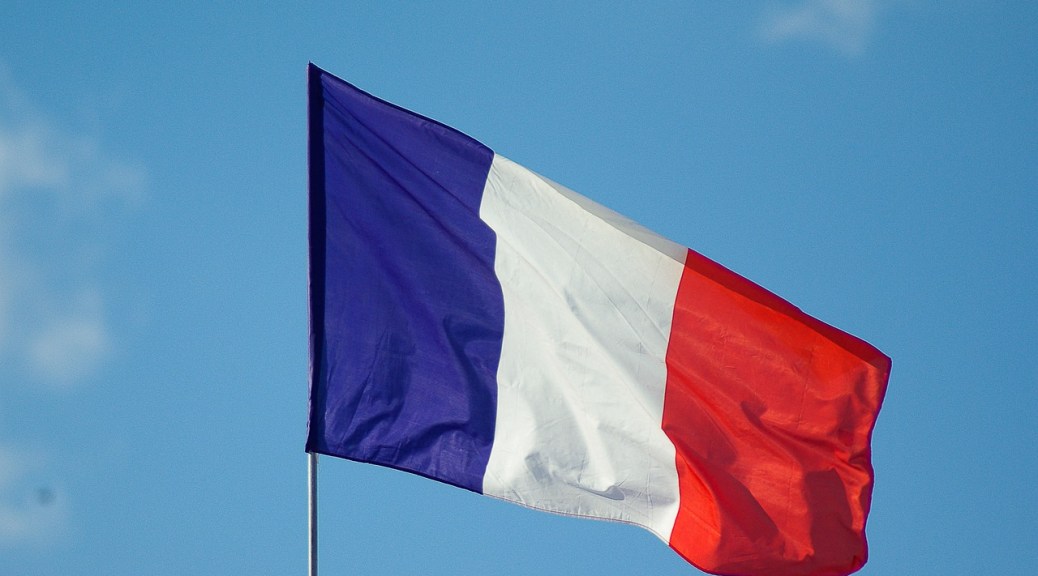
France, officially la République Française, is a republic in Western Europe and is Europe’s third largest state by area. France borders the English Channel to the north and northwest, Belgium and Luxembourg to the northeast, Germany, Switzerland and Italy to the east, the Mediterranean Sea and Monaco to the south, Spain and Andorra to the southwest and the Atlantic Ocean to the west. The island of Corsica (French Corse) in the Mediterranean also belongs to France. So does the overseas department of French Guiana, which borders Brazil and Suriname, while France and the Kingdom of the Netherlands share a border on Saint Martin in the Caribbean.
France is one of Europe’s oldest nation-states. France has been populated since the Stone Age, and already with the Franks from the 8th century, the forerunner of modern France arose. Throughout history, the country has been one of the most powerful in Europe, with famous rulers such as Louis XIV and Napoléon Bonaparte. The name France has its origins in the Franks, a Germanic people group who immigrated during the Migration Period, and their core area which was called the Frankish Empire. (Great Norwegian encyclopedia, Wikipedia).
The population in France was 67.4 million in 2021. The population density is lower than in the neighboring countries, with the exception of Spain. France has a very diverse population, with large ethnic minorities. The country has been characterized by greater immigration than most neighboring countries, including from former French colonies, not least from North Africa. The vast majority of the population lives in cities, not least in the most heavily industrialized parts of the country. Approximately 20 percent of the population lives in and around Paris with a population of approx. 2.2 million inhabitants. Several of the largest French cities have suburbs characterized by deindustrialization and poverty, which is an important source of social unrest.
France is among Europe’s most important industrial countries, and is a central member of the European Union (EU). France has meant a lot in Europe’s cultural history, both in art, literature and as a hotbed for new ideas. Not least throughout its political history, France has played a prominent role. The freedom symbolism of the French Revolution, liberté, égalité, fraternité, «liberty, equality, fraternity», has set the standard for many of the world’s democracies. There is a separation between church and state in France. Opinion polls show that the majority of the population consider themselves Catholic. France is one of the world’s most visited tourist countries. (Great Norwegian encyclopedia, Wikipedia; Google translated)
We have visited Paris several times in connection with oval weekend trips as well as Nice (Villefrance), Toulon and Le Havre in connection with cruises. We have mentioned the places we have been in France with a short info and with pictures in connection with this page in the blog.
Norsk:
Frankrike, offisielt la République Française, er en republikk i Vest-Europa og er Europas tredje største stat i utstrekning. Frankrike grenser til Den engelske kanal i nord og nordvest, til Belgia og Luxembourg i nordøst, Tyskland, Sveits og Italia i øst, Middelhavet og Monaco i sør, Spania og Andorra i sørvest og Atlanterhavet i vest. Øya Korsika (fransk Corse) i Middelhavet hører også til Frankrike. Det samme gjør det oversjøiske departementet Fransk Guyana, som grenser til Brasil og Surinam, mens Frankrike og Kongeriket Nederlandene deler grense på Saint Martin i Karibia.
Frankrike er en av Europas eldste nasjonalstater. Frankrike har vært befolket siden steinalderen, og allerede med frankerne fra 800-tallet oppstod forløperen til det moderne Frankrike. Opp igjennom historien har landet vært en av de mektigste i Europa, med berømte herskere som Ludvig XIV og Napoléon Bonaparte. Navnet Frankrike har sin opprinnelse i frankerne, en germansk folkegruppe som innvandret i folkevandringstiden, og deres kjerneområde som ble kalt det frankiske rike. (Store norske leksikon, Wikipedia).
Innbyggertallet i Frankrike var 67,4 millioner i 2021. Folketettheten er lavere enn i nabolandene, med unntak av Spania. Frankrike har en svært sammensatt befolkning, med store etniske minoriteter. Landet har vært preget av en større innvandring enn de fleste nabolandene, blant annet fra tidligere franske kolonier, ikke minst fra Nord-Afrika. Det store flertallet av befolkningen bor i byer, ikke minst i de mest industritunge delene av landet. Cirka 20 prosent av befolkningen bor i og rundt Paris med en befolkning på om lag ca. 2,2 millioner innbyggere. Flere av de største franske byene har forsteder preget av avindustrialisering og fattigdom, som er en viktig kilde til sosial uro.
Frankrike er blant Europas viktigste industriland, og er et sentralt medlem av Den europeiske union (EU). Frankrike har betydd mye i Europas kulturhistorie, både innen kunst, litteratur og som arnested for nye ideer. Ikke minst gjennom sin politiske historie har Frankrike spilt en fremtredende rolle. Frihetssymbolikken fra Den franske revolusjon, liberté, égalité, fraternité, «frihet, likhet, brorskap», har satt standarden for mange av verdens demokratier. Det er skille mellom kirke og stat i Frankrike. Meningsmålinger viser at flertallet i befolkningen anser seg som katolikker. Frankrike er et av verdens mest besøkte turistland. (Store norske leksikon, Wikipedia)
Vi har besøkt Paris flere ganger i forbindelse med ovale weekendturer samt Nice (Villefrance), Toulon og Le Havre i forbindelse med cruise. Vi har omtalt stedene vi har vært i Frankrike med en kort info samt med bilder i tilknytning til denne siden i bloggen.
 Vår vidunderlige verden